Signs of Oil on Your Land: Finding Geological Traces
When property owners think about discovering hydrocarbons, they often picture a dramatic, Hollywood-style geyser of black crude shooting into the sky. In reality, the true signs of oil on your land are far more subtle and require a keen, educated eye. Recognizing the physical, chemical, and geological signs of oil on your land is less about striking it rich with a pickaxe and more about understanding the complex natural science and historical data of your region. Whether you own a few acres or a massive ranch, learning to read these clues can help you understand the true subsurface value of your property.
Historical and Geographic Clues
The strongest and most statistically accurate signs of oil on your land usually lie just beyond your property line. Hydrocarbon deposits do not exist in isolated, perfect circles; they run in massive geological trends or “belts.”
If your neighbors recently signed mineral leases, or if active offset wells are operating within a few miles of your property, the statistics heavily favor your parcel being part of that same geological trend. Proactive landowners should search public registries to track this activity. For example, using the North Dakota Industrial Commission (NDIC) public GIS maps allows you to see the exact locations of permitted, active, and historical wells. If your land sits directly between two highly productive wells, that geographic positioning is one of the most reliable signs of oil on your land.
Finding Surface Signs of Oil on Your Land
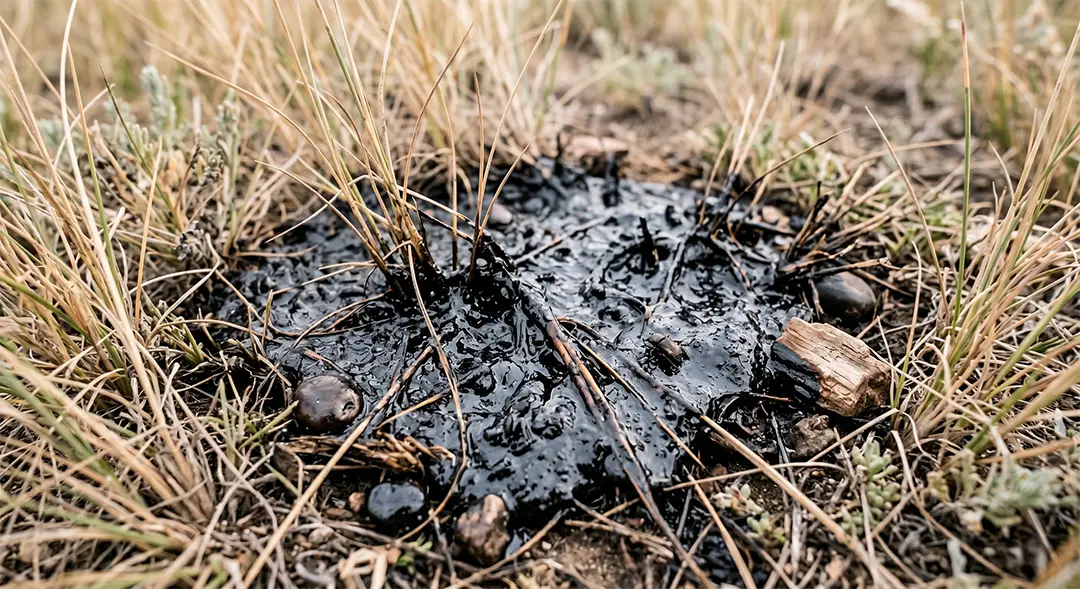
In regions with shallow geological basins, physical signs of oil on your land can manifest directly on the surface as “oil seeps.” This happens when geological faults allow crude oil to migrate upward, mixing with the topsoil to form dark, sticky, asphalt-like patches.
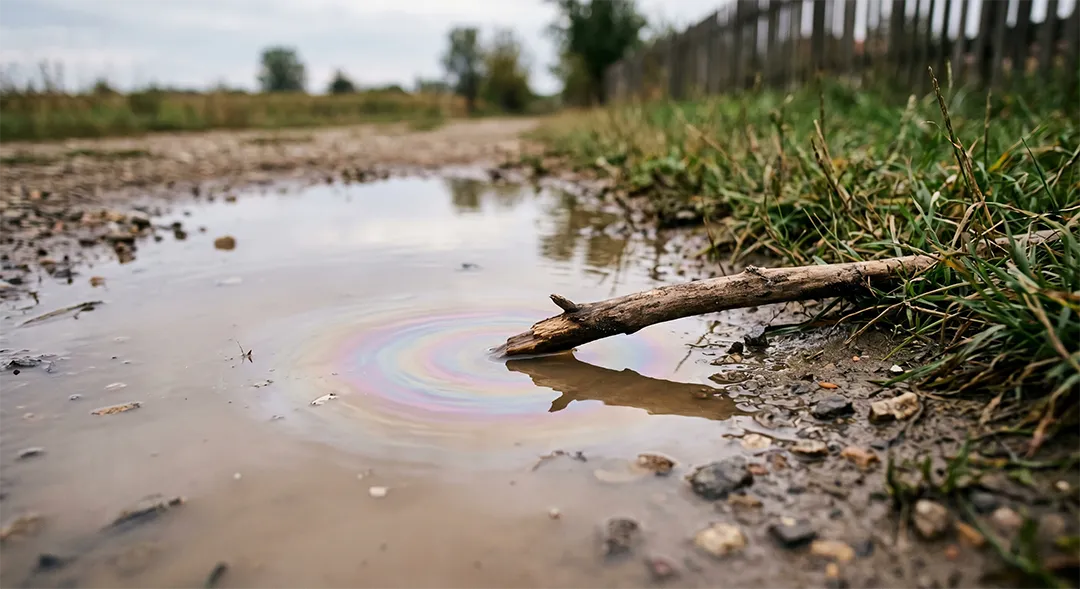
However, landowners must be careful not to confuse biological processes with actual petroleum. A common mistake is seeing a rainbow sheen on a puddle or pond and assuming it is an oil spill. You can easily test this using a method backed by geological science: poke the rainbow slick with a stick. If the sheen shatters and cracks like glass into distinct jagged pieces, it is simply harmless iron bacteria naturally found in groundwater. If the slick swirls around the stick and immediately rejoins into a cohesive, oily film, you are looking at genuine surface signs of oil on your land. Furthermore, discovering specific rock outcroppings, such as highly porous sandstone (reservoir rock) or dark, organic-rich shale (source rock), strongly indicates that the area is capable of generating and trapping hydrocarbons.
Water Anomalies and Natural Gas Bubbles
Because oil and natural gas are lighter than water, they constantly try to migrate upward through permeable rock layers. As a result, subsurface reservoirs directly impact surface and groundwater sources, which are heavily monitored by agencies like the U.S. Environmental Protection Agency (EPA).
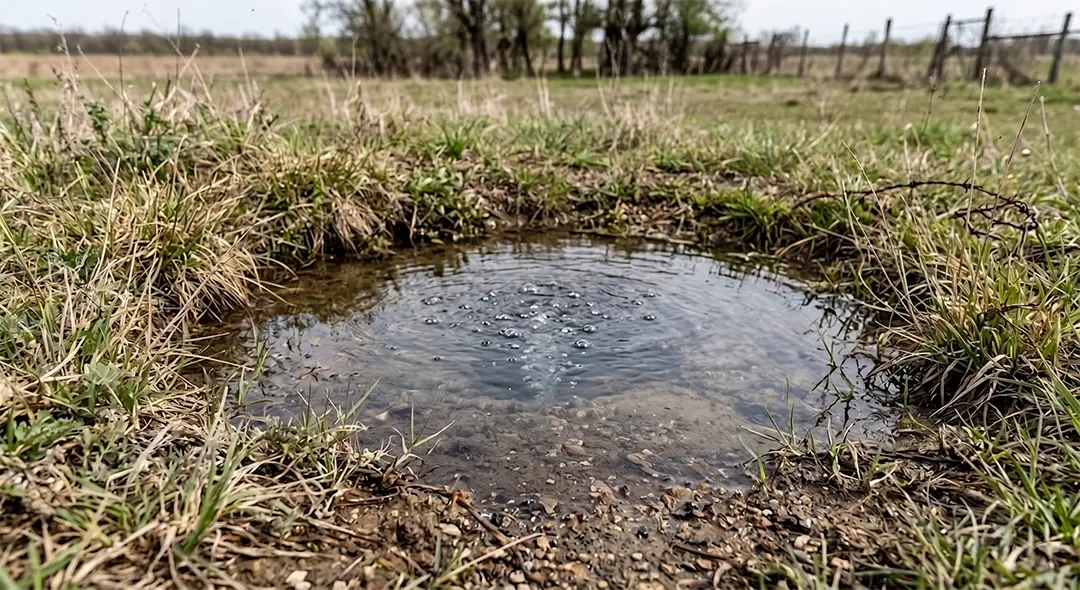
Unexplained natural gas (methane) bubbles continuously rising in your water wells, creeks, or standing ponds are major red flags. Methane travels faster than heavy crude, making it an early indicator of deep reserves. Furthermore, detecting a distinct sulfur (often described as rotten egg) odor, caused by Hydrogen Sulfide (H2S) or a raw petroleum smell near your water sources ranks among the most classic, unmistakable signs of oil on your land. Sudden, unexplained spikes in water salinity (brine) can also indicate that deep formation waters, which often sit beneath oil traps, are mixing with your groundwater.
Identifying Soil-Based Signs of Oil on Your Land
When deep hydrocarbon gases leak at a micro-level over decades, they feed specific hydrocarbon-oxidizing bacteria in the soil. This biological consumption fundamentally alters the ground’s chemistry.
The bacteria leave behind complex organic residues, creating distinct patches of soil known in the industry as “paraffin dirt.” This dirt feels rubbery or waxy to the touch, often has a yellowish-brown tint, and absorbs water very poorly compared to the surrounding soil. Discovering these unexplained, waxy patches, or suddenly finding white, salty mineral deposits on the surface where none existed before, provides subtle yet scientifically proven signs of oil on your land.
Microseepage and Vegetation Changes
The invisible upward migration of gases (microseepage) fundamentally alters soil pH, oxygen levels, and mineral composition. As a result, the root systems of surface plants are directly affected.
You might notice localized areas where plant growth is inexplicably stunted, or where trees seem to die off while surrounding areas thrive. Conversely, specific mineral-loving weeds might suddenly flourish in one highly localized patch because the leaking gas has reduced the iron in the soil, changing its chemical makeup. Reading these unexplained vegetation anomalies helps geologists pinpoint indirect signs of oil on your land that are hidden thousands of feet beneath the surface. 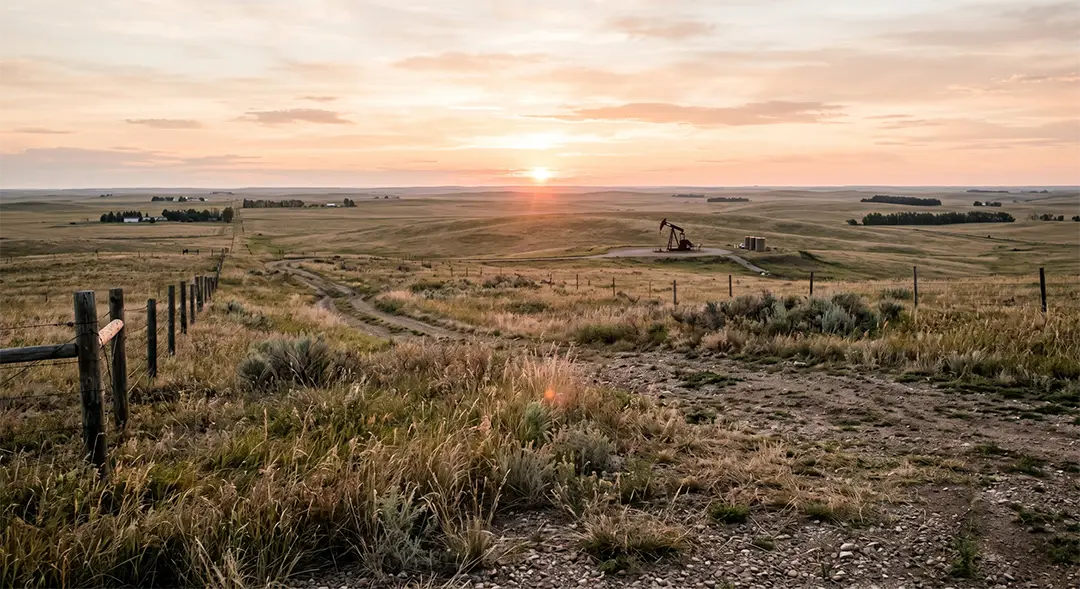
The Bakken Reality: North Dakota Signs of Oil on Your Land
It is crucial to understand that geology changes by state. In unconventional “tight oil” plays like the Bakken formation in North Dakota, the crude sits trapped in dense shale rock over two miles (10,000+ feet) underground, securely sealed by impermeable caprock.
Because of this extreme depth and solid rock seal, surface seeps or paraffin dirt are practically nonexistent. In North Dakota, the true signs of oil on your land are entirely administrative and industrial. You know you have potential when large seismic “thumper” trucks are seen mapping the county roads, when operators mail you requests for seismic surveying access, or when deep pay-zone data published by state geologists highlights your specific township.
You Found the Signs of Oil on Your Land: What Is the Next Step?
Spotting physical or historical signs of oil on your land is an exciting discovery, but it means absolutely nothing without legal ownership. In the United States, and especially in states like North Dakota, the “Surface Estate” (the grass, dirt, and home) is often severed from the “Mineral Estate” (the oil, gas, and coal beneath it), a concept known as a Split Estate.
Before you invest time or money into your discovery, you must confirm that your ancestors did not sell or reserve the mineral rights decades ago. By utilizing the professional oil and gas services at BJK, you gain access to expert landmen who specialize in running comprehensive Title Searches. They dig through decades of complex county courthouse records, deeds, and probate files to verify your exact mineral ownership, ensuring that you have the legal right to profit from the resources hiding beneath your feet.
Conclusion
Identifying the signs of oil on your land is a fascinating process that blends hands-on geological science with sharp historical research. By learning how to read the water, the soil, and the public records, landowners can stay informed, protect their property, and safely unlock their land’s hidden energy value.